When I was in middle school, I used to babysit for M, a precocious little boy with a wild and active imagination. After watching the requisite episode of Arthur or The Magic School Bus, he would launch into an elaborate fantasy game with mysteries that had to be solved, villains (mostly robbers - it was a simpler time) who had to be foiled, and magic that could be used for the powers of good. I played in my role in these pretend scenes and helped him make his vision come to life. Once he remarked that his parents didn't like him to play pretend and thought he should focus on the real world. Even at my young age, I knew they were wrong. To inhibit this drive to explore imagined worlds would deny an essential part of his development. And I confess that these games helped foster my own imaginative play; I created an intricate fantasy world called The Dynasty that I used to sort through my adolescent drama and developed an understanding of narrative that I still use in the stories I write. It may seem counter intuitive, but by pretending, M and I actually dealt with our very real feelings and fears in a safe space where there were no wrong or dangerous choices, just ways of examining our own identities and inner world. We could pretend to walk a mile in someone else's shoes - and then return home for supper. And it would still be hot.
This was the memory that replayed in my head while reading Doll Bones by Holly Black. Zach, Poppy, and Alice are best friends who share wonderful games of swashbuckling and adventure with their action figures, the pirate, William the Blade and Lady Jaye, a thief. These games center around the machinations of The Queen, a creepy china doll who lives in Poppy's cabinet. But tragedy strikes our heroes when Zach's father throws away his action figures, which includes William the Blade. Like M's parents, Zach's father believes that Zach is too old for make-believe. Zach's heart is broken by his father's thoughtless decision and it propels him to reject his role in their fantasy play to deal with his pain. As the outside world infringes on their fantasy realm, Poppy reveals that she is being haunted by The Queen, who was created from the bones of a girl who was murdered, and can only rest once she is finally buried in her grave. The lines between fantasy and reality blur as the children embark on a real quest that tests their friendship at the edge of adolescence.
At 12, Zach, Poppy, and Alice are still at an age to embrace adventure and fantasy play, but inevitable changes loom that threaten the realm of childhood. Poppy, in particular, has difficulty accepting these changes, saying, "And I hate that both of you can just walk away and take part of my story with you and not even care...I hate that everyone calls it growing up, but it seems like dying. It feels like each of you is being possessed and I’m next.” Growing up is terrifying - and certainly feels like being possessed by an otherworldly force that makes you do and feel new and sometimes less than pleasant things. It takes an epic quest for Zach, Poppy, and Alice to start the process of sorting through this transition. The children need a space where they can try on new roles, especially when the ability to play is taken from them. My heart broke for Zach when William the Blade was thrown into the garbage. The pirate enabled Zach to feel brave and heroic, to take on an identity where he could sort through his own tangled relationship with his father through William's story. Without William, Zach bottles up his feelings and denies an essential part of himself. Children have so little control of the world around them, but during play, they are the masters of their destinies. During the quest, the children are brave and resilient, using their intelligence and creativity - and excellent research skills (thanks to a fabulous pink-haired librarian), I may say, to solve problems and the mystery of the china doll.
As educators and librarians, we can make our classrooms and libraries into spaces that value imagination and provide opportunities for play and creativity. Wonderful libraries like Evanston Public Library and Skokie Public Library have huge areas set aside for imaginative play, where children can interact in fantasy worlds, create fabulous towers and tools, and engage with their peers and/or caregivers in story-building. These efforts are promoted by professional organizations like ALSC, the Association for Library Service to Children. Play was one of the main topics discussed during the ALSC membership meeting I attended at ALA. They discussed the Read! Build! Play! initiative "designed to develop early literacy skills through play." Sue McCleaf Nespeca shared her white paper outlining the importance of play, especially constructive play. It is an essential resource about developmental and educational underpinnings for play programming in libraries. While it focuses specifically on play in the lives young children, its message can be applied to the experiences of older children and adolescents. Children can use play to take on STEM challenges, to explore and discover ways to solve problems and create tools and machines of their own. During Evanston Public Library's Teen Loft Fuse program, I have seen young adults come up with novel and creative solutions to hands-on challenges. What started with Legos and blocks as toddlers has turned into robots, circuits, and ringtones as teens. And believe me, the look of joy after creating something wonderful is the same, no matter the age. Inquiry-based programs like Fuse can help children engage in problem solving that is relevant and purposeful. Steven Wolk has developed an incredible resource, Caring Hearts & Critical Minds: Literature, Inquiry, and Social Responsibility, to provide educators with tools for creating inquiring-based units of study based on literature that help shape "human beings with intellectual curiosity as well as caring
hearts." Wolk citesDeborah Appleman, saying, that reading in school is “a
matter of creating and re-creating fresh and unrehearsed opportunities to make
discoveries about texts, about language, about the world, and about themselves.” When children investigate the world through provacative questions that demand critical thinking and collaboration, they gain a deeper understanding of who they are in the process. From examining the right to life and abortion in Neal Shusterman's Unwind to government control and personal freedom in Pete Hautman's Rash, inquiry-based literature helps readers think about what it means to be human. Books help readers develop their own sense of self by experiencing someone elses's life and examining their reactions and emotions in these worlds. Esme Raji Codell made this experience tangible when she created a time travel machine for reading in her classroom in her memoir,Educating Esme. "For the rest of the day, the children took turns in the time machine. So far, nobody has said, 'It's just a box full of books.' " In Madame Esme's classroom and school library learning is more like play, a forum for exploration of things children are passionate about, and education is an act of imagination. Like Madam Esme, we can create spaces where refrigerator boxes can become time machines, where children can be become fearless adventurers, who can reunite ghosts with their loved ones, where children can act out stories without fear of ridicule or judgement. We can show that we value their imaginations and are ready to play.
Resources Want to continue the conversation? Two Twitter Chats about Doll Bones will be happening this month! Virtual Book Club Niki Ohs Barnes (@daydreamreader) and Beth Panageotou (@epan11) are the hosts of the Virtual Book Club. They will be talking about Doll Bones on Monday, August 5th at 9 p.m. EST/ 8 p.m. CDT on Twitter. Use the hashtage #virtualbookclub to join in. #Dollbones Twitter Chat
Date: Thursday, August 15, 2013 Time: 8 p.m. Eastern, 7 p.m Central, 5 p.m. Pacific- The chat will run for an hour. Hashtag: #dollbones
To participate in the Twitter chat, simply tweet your comments about Doll Bones using the hashtag #dollbones at the end of each tweet. Don't forget to respond to or Retweet others' comments. (For an example of a fabulous Twitter chat, check out the #sharpschu chat. Just do a search for this hashtag on Twitter and be amazed.)
Most importantly, Holly Black herself will be participating in the chat. So get your most pressing Doll Bones questions ready for the author herself!
It has been almost impossible to describe the
experience of attending this year’s American Library Association conference in
Chicago. I try to explain what made it so wonderful and epically fail each
time. I feel a rush of emotions, a Maria the-hills-are-alive kind of elation
that makes me want to do a happy dance and burst into song. (Well, I guess
since I did burst into song during ALA(publicly, I might add), this feeling makes sense.) When words fail me,
art helps capture the moment. I turned to my art form of choice, Modge Podge
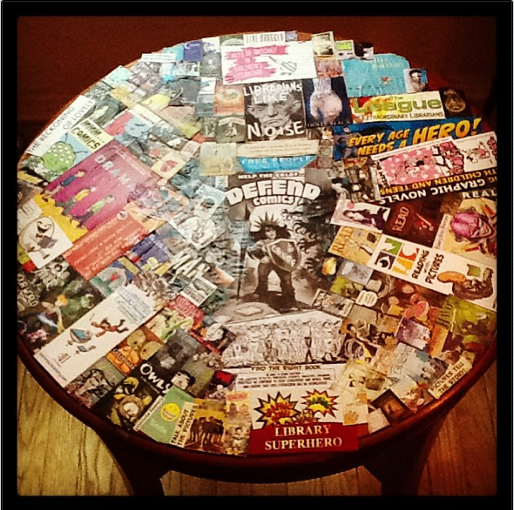
collage, to commemorate this awe-inspiring experience. I turned my end tables
into ALA2013 tributes. That’s right; my living room is now tricked out with
beautiful one-of-a-kind ALA tables.
Creating a tangible symbol of this experience
of a lifetime somehow makes it easier to articulate my garbled thoughts. So
here are some of the highlights of my ALA 2013 experience:
Making
Mischief
I could think of no
better way to start off my ALA experience than attending "Celebrate the
Life of One of Children’s Literature’s Luminaries: A Peter Sieruta Event." Peter D. Sieruta passed away a year ago. Like
many, I followed his blog, Collecting
Children’s Books, an endless resource for all things related to
children’s literature and sought his insights for many a research paper. This
event celebrated his life and legacy, and it was incredible talking with people
whose lives he had touched with his critical scholarship, keen insight, and
passion for children’s books. This event celebrated the publication of his
book, Wild Things!: Acts of Mischief in Children’s Literature,
co-authored with Betsy Bird of Fuse#8 and Julie Danielson of 7
Impossible Things. “Secret lives, scandalous turns, and some very
funny surprises – these essays by leading kids’ lit bloggers take us behind the
scenes of many much-loved children’s books.” Due to be released in April 2014
by Candlewick Press, this book promises to, according to Bird, “effectively put
down the notion of children’s authors as fluffy, silly individuals.” I already
plan on adding this text to my future children’s literature class and can’t
wait to read it. I was delighted to have the opportunity to discuss it with
Betsy and Jules and learn more about the process of creating this important
work. It felt incredibly surreal to be there among the crème de la crème of the
kidlitosphere. I stood by while Helen Frost, author of the amazing Keesha’s
House and recently Salt: A Story of Friendship in a Time of War,
chatted with them – and engaged me in conversation. I even briefly met Roger
Sutton of Horn Book. Fortunately, in the children’s literature
world, I have found everyone to be kind and welcoming of noobs and eager to
share and listen.
Give Me One Reason
ALA provides so many incredible opportunities to
take – take ideas, generate enthusiasm, and yes, grab free books, but this
conference provides equally important forums for giving. As a librarian,
my natural state is to provide information, share resources, and give back to
my community, so it makes sense that I am most comfortable in my role as a
volunteer during ALA. I had the chance to give back to my alma mater, the Graduate School
of Library and Information Science at the University of Illinois at
Urbana-Champaign, and help in their booth in the exhibit hall. I
enjoyed connecting with staff, alumni, current and incoming students and
swapping perspectives on librarianship. I am truly grateful for the excellent
education I received at GSLIS and volunteering at ALA always reminds me of how
valuable that experience has been.
My time at GSLIS reignited my passion for comics,
thanks to Dr. Carol Tilley’s class, Comics: Advising Child and Adult Readers.
Thanks to her, I had the opportunity to interview some of my favorite graphic
novelists in the Artist Alley. In true geek girl fashion, I
spent hours crafting questions to ask the graphic novelists about their books,
craft, and the importance of comics. It was a huge honor to be able to film
these interviews for ALA and connect with the authors in a more personal way. I
will be sure to post the videos on the blog once they are shared on the ALA YouTube channel. But I will say that the videos include references to ancient
storytelling in the modern era, embracing your inner geek, and why sisters and
snakes do not mix.
Volunteering is all well and good, but it’s
important not to melt into a puddle in the process. I had the incredible
opportunity to volunteer at the Newbery-Caldecott-Wilder Banquet, otherwise
known as the Academy Awards of children’s literature. Show me a Hollywood star
and won’t bat an eyelid, but introduce me to an author of a coveted picture
book and I will lose all respectability. As I directed people towards the
banquet hall, a dapper author dressed to the nines approached me. He pointed to
the Caldecott75
pin I sported and said simply, “I made that.” I was talking to Brian
Selznick himself, author of the 2008 Caldecott winner,The Invention of Hugo Cabret, one of my
favorite books of all time. I’d like to think I said something charming and
appreciative because the logo is beyond beautiful, but it’s more likely that I
sputtered incoherently in an epic fangirl moment. In the presence of these
great artists and authors, it is almost impossible not to become verklempt.
It was a surreal experience to share in an event that brings together the
biggest names in children’s literature, and I am so grateful to be able to
assist in my small way.
Channeling my Inner Eleanor Roosevelt
Standing in front of massive lines of people
waiting for the exhibits, I had the stunning realization that I was an
introvert preparing to sing in front of a crowd of people. I wanted to flee to
a dark corner, but my inner resolve to do one thing that scared me each day
would not let me slink away. I forced myself to embrace my fear Dune-style and
thanks to a pep talk from a friend, I donned my stolen hat and prepared to take
on the crowd. Together with a group of brave friends, colleagues, and even some
strangers, we joined in a flashmob to celebrate the 75th Anniversary of the Caldecott Medal. We sang the song I had written for the occasion, “Read Caldecotts from our Libraries,” and tried to convey how much we love and
appreciate picture books. It was both a terrifying and electrifying experience.
What started out as a whim, a crazy idea to spread the message about the
Caldecott75, turned into a transformative experience about the endless
possibility of a supportive community. My inner doubts faded away with the
support of my fellow flashmob-ers, colleagues, friends, and mentors. I would name
everyone individually here but for fear of accidentally omitting anyone, I will
simply express my gratitude to everyone who promoted, supported, participated,
attended, or watched the flashmob. Thank you for making this dream come true!
It’s a
Bird... It’s a Plane... It’s a Library Superhero
I am in deep, passionate love with comics and
I don’t care who knows. I swoon at double-page spreads, sweeping action that
happens between panels, and close-ups of characters’ faces, full of emotion. I
am not alone in this love affair. Librarians and educators have taken on the
torch to advocate for comics in their libraries and classrooms. ALA recognizes
our devotion for comics and believes in the inherent value that this medium
offers to all readers. Forums for engagement about comics included the Graphic
Novel Stage, Artist Alley, Zine Pavilion, as well as sessions about comics by
experts and artists. Not surprisingly, these were some of my favorite sessions
at ALA.
I attended this interactive game show where “volunteers are
paired off with (or against) professional cartoonists in a series of fun-filled
drawing challenges!” Hilarity ensued as Dave Roman hosted a chaotic session of fast-paced drawing by professional artists to create complete
comics with little time to spare. Fabulous stories about a radioactive rat and a dangerous storm and dark tale of an octopus and mutant mermaid proved just how delightful and spontaneous this
medium can be. I’d love to see this activity replicated in classrooms and
libraries around the country to show the joy in creating and reading comics. Busting
the Comics Code: Comics, Censorship, & Librarians
Moderated by the fabulous Robin Brenner of No Flying No
Tights and Brookline Public Library in Boston, this panel focused on
the issues related to intellectual freedom, censorship, and advocacy for comics.
I was particularly looking forward to hearing Dr. Carol Tilley discuss her research on
Fredric Wertham, author of Seduction of the Innocent, a seminal text
that devastated the comics industry. I learned that Wertham had received
letters from young readers debunking his assertions that comics would lead them
to a life of crime and sin. (He didn’t respond to these letters, but he did
edit the grammar and spelling.) Dr. Tilley had been able to view Wertham’s
papers and actually track down some of the writers of these letters, who shockingly
had become upstanding members of society. I was gratifying to hear that a child
who loved science fiction comics grew up to become a successful writer. She
found that Wertham’s research was contrived, misleading, and falsified. Wertham’s
legacy, the Comics Code, still has ripples in attitudes towards comics today.
The panelists, Brian Azzarello,Carol Tilley, Charles
Brownstein, Gene
Yang and Raina
Telgemeier, discussed how far the comics industry has come, but how
are they are miles to go before we sleep. Comics are still marginalized and
librarians need to advocate and support them. I have had many interactions with
parents and educators who reject comics and want their children or students to
read “real books.” It is up to us to change this mindset and get comics back to
their rightful place. Fortunately, we have allies like the participants of this
panel, the Comic
Book Legal Defense Fund and Reading
with Pictures to lead the charge for comics.
We Want YOU for Reading With Pictures!
After missing a similar session with Dr.
Tilley at C2E2, I was determined to attend this session about the Common Core
Standards and comics, using comics for instruction, and comics curricula. Dr.
Tilley illustrated (pun intended) how the Common Core’s call for text complexity means going beyond readability formulas
to actual content in comics. Using examples from Toon Books and Isadora Duncan:
a Graphic Biography, she showed how the images and text are examined together
to create meaning. (You can listen to the C2E2 session here to get the full
picture of her presentation.) Her advice
for using comicswas toread a lot,
connect with other texts, look for natural fits, and most of all, to have fun.
Josh Elder of Reading with Pictures shared their initiatives to promote comics,
in particular The Graphic Textbook, which was funded through Kickstarter. It is a
resource for teachers aligned with the Common Core that supports best practices
in teaching. After seeing a sample of this text in action, I desperately wanted
to pull a Billy Madison and head back to elementary school. Fortunately, I can
incorporate this text as an instructor of pre-service educators and ensure that
they know how to include comics as a vital part of their classroom. Another
amazing resource that Elder shared was the teaching resource repository created
by teachers for teachers. I can’t wait to submit my own comics lessons to
Reading with Pictures. In addition, there is also a wealth of literature on the
research and rationales for using comics in education. Jim
McClain then shared how he created a comic to teach math called the Solution Squad, which was an ingenious concept and highly motivating to learn math this
way. He produced the comic himself and digital version is available at
Comixology. Armed with these resources, we will be
unstoppable!
90-Second Newbery
It’s no secret that I'm a superfan of the 90-Second Newbery Film Festival. After submitting my interpretation of Madeleine
L’Engle’s A Ring of Endless Light, I
was hooked. Since then I have supported the film festival by conducting
research and managing its Facebook and Twitter pages. I was thrilled when the
film festival was selected as a Conversation Starter at ALA.As expected, festival host and author of The Order of Odd-Fish, James
Kennedy, put on a hilarious and entertaining show to a packed room. (The supercut
of submissions of The Giver release
scene received a particularly positive response; I know I couldn’t stop
laughing.) In between videos, Kennedy provided suggestions for successful video
submissions like genre-twists and creative storytelling approaches. He also
shared ideas for making videos on a limited budget with basic technology. After
all, anyone can make a green screen with some bulletin board paper. The
possibilities are endless with enough creativity, which we know our young
patrons and students have in spades.
Lessons Learned
Attending a conference with 26,361 other people is
daunting, to say the least. Think of it as a conversation with thousands of
people and I have no idea where to put my hands or to maintain eye contact or
not. Navigating the sea of social interactions makes attending conferences
challenging, but after the fact, I remember to be kind to myself - and so
should you. While I had lots of good advice in my pocket, I didn’t take much
of it. I have accepted the inevitability that I couldn’t do everything despite
my uber-planning. I would have loved to see Julie Jergens of Hi Miss Julie! perform at the Guerrilla Storytime (Fortunately, someone did
record her New Adult panel song here.) Maybe next year I’ll even work up the
courage to present something myself... I will definitely seek out other
opportunities like the Networking Uncommons, Makers
events and Zine
Pavilion during the next conference. While I did attend the
Newbery-Caldecott-Wilder and Printz Awards, I hope to attend the ALSC Awards
Presentation for the Batchelder, Carnegie, Geisel, and Sibert
Awards, as well as the Odyssey Awards. I also hope to have the
opportunity to give back to the divisions like ALSC, YALSA, and AASL, who were
instrumental in making my ALA experience a success.
I also know what I will not do next year. As
Suzanne Walker said in her ALSC blog post about ALA, the exhibit hall is “really
more like Wonderland than any Hunger Games Arena.” True, the exhibit hall
offers glorious wonders and experiences, from publishers, authors, artists, and
vendors, but at some point, the masses of people make the experience take a
dark turn. Instead of focusing on grabbing the latest ARC or freebies, I plan
on taking advantage of more sessions, more learning opportunities, and more
chances to connect on a human level with my fellow librarians. In the end, it
is the wonderful conversations and encounters, the lunches catching up with
friends, the shared sessions with colleagues and the moments with strangers,
that make ALA an unforgettable experience. Knowing I am not alone in our
profession – and I have the support of the divisions to achieve my mission- is
the true takeaway from this experience. And all I have to do is look at my
tables to remember it.
Resources
Whether you attended ALA 2013 IRL or virtually, here are some resources for you to continue the celebration of our profession and bring it back to your libraries or schools.
Creating Collage Table
For DIY fans and people looking for creative
programming, you can try something similar in your library. Grab a collection
of comics, magazines, old art catalogs, etc. and a supply of modge podge and
brushes. Select an item to be decorated that you will want to seal – like a
table or even a picture frame. To seal the images, first make sure the images are all
glued down completely. In a very well ventilated area, use epoxy resin to cover
the table. The options are endless, as you can see here.
Caldecott 75 Resources
The amazing ALSC Caldecott 75th Anniversary Task Force
has pulled out all the stops to create a yearlong celebration of
all things Caldecott. Here are some of the incredible resources available:
The video below was played during this year's Newbery-Caldecott banquet and celebrates the 75th Anniversary. I confess I got choked up while watching it.
If you are in the Chicago area, make
sure to check out Caldecott exhibits that are currently being hosted by Skokie Public Library and the Art Institute.
Comics and Graphic Novels
The ALA Comic
Book and Graphic Novel Member Initiative Group works to support the
inclusion of comic books and graphic novels and “advocate for wider
incorporation and acceptance by the profession and the Association for comic
books and graphic novels in library services, programming, and collections.”
Start participating in their initiatives here.
During ALA, there was a live recording of the
extraordinary Kids Comics
Revolution podcast with hosts Jerzy Drozd and Dave Roman, who were joined by Aaron Renier (Walker Bean) and Mary Ann Scheuer (Emerson School
Librarian). I can’t wait to hear this podcast when it’s released. Take
advantage of this amazing resource and listen to the archive of podcasts with
the likes of Alexis Fajardo (Kid
Beowulf and Peanuts; two podcast appearences, for the win!), Jarrett Krosoczka (Lunch Lady), Ben Hatke (Zita the
Spacegirl), Scott Robins (A
Parent’s Guide to the Best Kids’ Comics) and many more!
What an incredibly powerful video about comics! It's definitely going on my course syllabus - and favorite videos ever list.
Arianna from the amazing Wandering Librarians created an
in-depth post about Busting the Comics Code: Comics, Censorship, and Librarians. Read it here. Listen to the Integrating Comics session from C2E2 with Josh
Elder, Carol Tilley, and Jim McClain.